

Vibration testing for new product development of a fastener locking element
Article originally published in Fastener Technology International, April/May 2013 (“Testing” column). By Morten Schiff, Vibrationmaster, with Eddie Cahill and Robbie Adrian, Unbrako.
Testing plays a key role when developing new fastener and locking elements in response to customer requirements. The choice of testing enables fastener manufacturers’ Development Engineers to confirm that the new product performs according to specification. Downstream fastener consumers are constantly searching for innovative solutions to prevent self-loosening, a phenomenon first empirically investigated by Dr. Gerhard Junker in the 1960s. The result was the Junker test to determine self-loosening behavior, which has played a key role in the development of Unbrako’s new Durlok locking wedge washer.
“During the 1960s, Dr. Junker was working in Unbrako’s Koblenz facility in Germany when he completed his seminal work on the self-loosening behavior of bolted joints1, and which in turn led to the design of the original Durlok anti-vibration nuts and bolts,” explains Unbrako CEO, Eddie Cahill. “The Durlok 12.9 range is designed for high-performance critical applications and does not require a washer. However, our industrial original equipment manufacturer (OEM) customers requested a Durlok product in washer form for applications where it was deemed desirable to use a washer in the joint design. Thus we began researching new product development options.”
Where to start – standards
According to Unbrako Engineering Manager, Robbie Adrian, the first step in the development process is to identify the relevant engineering standards: “Downstream customer engineers need to know that the fastener products they specify will meet the required performance criteria within their design.”
As a result of the huge diversity of applications, Adrian highlights that new fastener products are manufactured to different standards from several different organizations. These include the International Organization for Standardization (ISO), the American Society for Testing and Materials (ASTM), the American National Standards Institute (ANSI), the American Society of Mechanical Engineers (ASME), the Industrial Fasteners Institute (IFI), and the Deutsches Institut für Normung (DIN).
Vibrationmaster CEO, Morten Schiff, adds that in some sectors, major customers have developed their own standards, which are often adaptations of existing international standards, but more oriented towards the OEMs’ own manufacturing processes. “OEM-based performance standards are widely adopted within the automotive and aerospace sectors,” he says. “When developing new products, fastener manufacturers must accommodate the requirements of OEM standards if they wish to supply these customers.”
Repurposing, not reinventing the wheel
Another key stage of Unbrako’s new product development strategy is to consider whether existing products can be repurposed to meet emerging customer needs. If repurposing is possible, it can save the fastener manufacturer time and money during the new product development process. Ultimately, this also reduces the price to the end customer.
Adrian explains: “Repurposing existing products can deliver many advantages. We already know for example how the fastener product is likely to perform and what standards it already meets. Naturally, we re-test new products to all the relevant standards, but with an adapted product there are less likely to be any surprises.”
When developing its new Durlok anti-vibration wedge washer, Adrian’s engineering design team went right back to first principles with the traditional Durlok anti-vibration nuts and bolts. These products conform to dozens of standards and have been consistently performing in highly demanding applications for over four decades. “Because our objective is to prevent self-loosening under vibration conditions, it all came back full circle to self-loosening behavior theories from Junker’s original work,” says Adrian.
Wedge washers are a new class of product for Unbrako, so although the Shannon, Ireland-based design team was able to apply many of the fastener technology lessons from Durlok nuts and bolts, it was effectively creating a brand new product. “We needed to thoroughly test the new washer under simulated operating conditions, so the choice of test regime was essential,” notes Cahill.
Identifying the correct test regime
The objective of the new wedge washer product was to prevent vibration-induced self-loosening in industrial applications using 8.8 and 10.9 grade fasteners. Adrian’s testing regime was broad as a result: “The downstream industries asking for wedge washers are diverse, spanning everything from industrial machinery in the processing and manufacturing sector, through to wind turbine and automotive manufacturers.
“The challenge was straightforward. We have customers seeking to maintain preload and eliminate self-loosening behavior in bolted joints, which in turn reduces the maintenance requirements and operating costs of the equipment they produce. So we needed to replicate operating conditions that for example included high-speed conveyors running 24/7, motors of various specifications, and even forklifts and other materials movement equipment.”
Schiff takes up the story: “Unbrako’s design team was looking for a vibration testing solution that could not only thoroughly test multiple washers, but could also accurately replicate the testing conditions. Consistency was essential, so that Adrian’s team could track the impact of its engineering decisions by directly comparing test results. The team wanted to be able to check how performance characteristics were affected as a result of modifications.”
Choosing appropriate test equipment
Unbrako has chosen Vibrationmaster’s J100 Junker test machine (see Figure 1) to vibration test the new wedge washer. The original Junker test bench, or transverse vibration test machine, developed by Junker and used in the past to assist Unbrako’s product development required manual set up. This was time consuming and did not allow for accurate replication.

“The J100 is software-driven, which allows the operator to specify the preload, the frequency and number of vibration cycles as well as to halt the test when the loss of pre-load reaches a predefined value,” continues Schiff. “Crucially, the tests can be exactly replicated and the results exported for analysis, enabling Unbrako to determine the exact impact of engineering decisions on the washer’s design and its resulting performance characteristics.”
Integrating testing within the new product development cycle
So having identified the applicable standards, the appropriate test regime and test equipment, the new product development process could begin by subjecting the initial washer designs to simulated operating conditions. The objective of the testing was to dynamically load the bolted joints incorporating the wedge washer to a range of vibration frequencies and cycles. The design team then made careful modifications to the wedge washer to enhance its anti-vibration characteristics.
Adrian estimates that the process to develop the new anti-vibration wedge washer has taken over 12 months to reach the stage, “Where we had repeatable product performance comparable to or better than the best established competitor product performance.”
The major stages within the development cycle closely followed the seven-step best practice template of Design and Development—Planning, Inputs, Outputs, Review, Verification, Validation and Control of Changes. “Following this template allowed us to clearly define our objectives in terms of function, performance and statutory and regulatory requirements as well as establishing product acceptance criteria,” continues Adrian. “The testing program conducted on the J100 test machine played a very important role in the verification and validation steps, allowing us to prove that the design and development outputs met the input requirements, and demonstrating that the Durlok washer was capable of meeting the requirements of its intended applications and uses.”
Some of the steps specific to the Durlok washer project included:
- Identifying which standards were applicable based on customer needs and likely applications.
- Taking note of technical advances and the direction of standards under discussion to “future-proof” new products.
- Understanding the anti-vibration characteristics of Durlok nuts and bolts.
- Evaluating whether any existing Unbrako products were appropriate.
- Carrying over the already-proven design characteristics of the Durlok nuts and bolts to the wedge washers.
- Developing prototypes and modifying the washer tooling.
- Multiple vibration testing and modifications to incorporate engineering decisions.
- Further testing to confirm that the washer’s resulting performance characteristics were in-line with the product development team’s expectations.
- Ongoing testing and adjustment based on customers’ feedback and new requirements, possibly leading to further new products.
Adrian and Cahill both agree that the vibration testing has not only shortened the product development cycle, but also provided a significant marketing boost for the product.
Customer acceptance of vibration test results
“Design Engineers within our downstream customers are mostly aware of the theory of self-loosening behavior under vibration conditions and Junker’s original work,” says Cahill. “When we launched the new anti-vibration Durlok wedge washer (see Figure 2) at Fastener Fair Stuttgart in 2013, the response was fantastic and customers could immediately understand the implications.

“End-users are looking for anti-vibration solutions that not only prevent bolted joint failure, but also enable the bolted joint to retain its preload, thus reducing maintenance requirements. The test regime highlighted this feature, which has been appreciated by industrial original equipment manufacturers producing high-use machinery and equipment applications in less accessible locations such as energy, oil and gas and wind turbines.
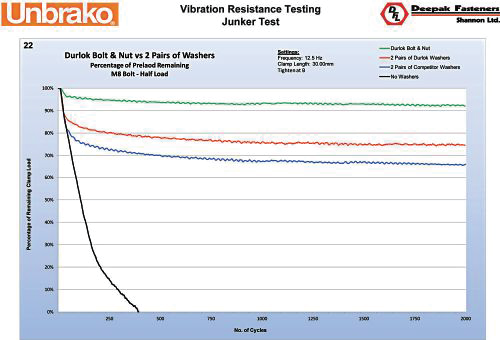
“We were also able to test our new washer and show customers how the loosening curve (see Figure 3) developed in real time actually at the Fastener Fair Stuttgart (see Figure 4). In addition to the benefits for our product development processes, integrating vibration testing has had huge production, marketing and sales benefits.”

Continuous improvement
As part of its continuous improvement strategy, now that the wedge washer has been launched and shown by vibration testing to perform according to specifications, product development work won’t stop. Cahill and Adrian believe that continuing to vibration test the washer in response to customer requirements will ensure that the Durlok wedge washer’s performance will continue to improve and become useful in even more applications.
Cahill continues, “Once downstream end-user customers accept the validity of fastener and locking element tests, and the resulting confirmation of how the bolted joint should perform under simulated operational conditions, new products are much more readily accepted. That’s because, in effect, there is an independent verification that the fastener does what it says on its specification.” And Cahill concludes, “If the fastener testing equipment enables you to actually show customers how well it performs, that provides an added marketing boost.”
Reference
- Junker G, New Criteria for Self-Loosening of Fasteners Under Vibration, Transactions of the Society of Automotive Engineers, Vol. 78, 1969, pp. 314-335, New York. ↩︎
Co-authors: Unbrako – premium socket screw products and the Durlok range of free-spinning vibration resistant bolts, nuts and wedge washers; part of the Deepak Fasteners Group. www.unbrako.com
Download the original article: Fastener Technology International, April/May 2013 (PDF)
