
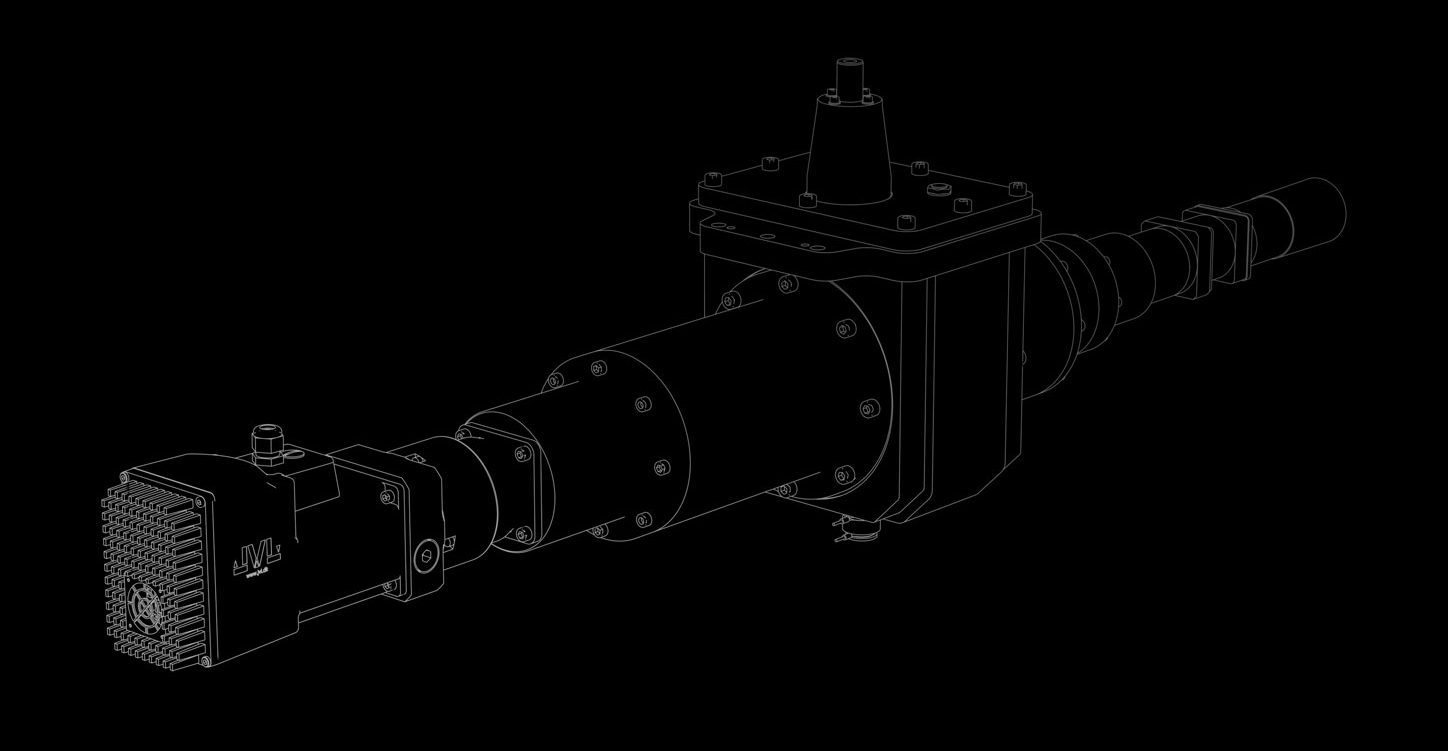
The Variator Drive is a mechanical eccentric actuator drive that converts continuous rotation into controlled linear oscillation, with a stroke that is adjusted electronically while the drive is running.
Coupled with a main drive motor, an eccentricity control motor and closed-loop control, it delivers any stroke up to ±12.5 mm, axial force up to 200 kN and frequency up to 200 Hz — each within its series envelope, controlled accurately in real time, without stopping the machine.
Proven in continuous service in Vibrationmaster’s own closed-loop test platforms, the Variator Drive is available to machine builders — as a supplied drive unit, or as a technology licence for integration into your own product.
Four series
ForceMax
Maximum axial force. Force classes up to 200 kN, full force available across the entire stroke range.
SpeedMax
Maximum frequency. Frequency classes up to 200 Hz, for high-cycle work at controlled stroke.
StrokeMax
Maximum stroke. Stroke classes up to ±12.5 mm, adjustable down to zero.
CleanLine
The Variator Drive in stainless steel, for the food, pharmaceutical and packaging industries. 316L stainless steel construction, hygienic design with smooth, easy-to-clean surfaces and no residue traps, IP69K washdown protection, resistant to industry cleaning agents, food-grade lubrication.
Each drive is configured to the application: stroke, axial force, frequency, drive power and interface, engineered per requirement.
Request details
How it works — and why nothing else works this way
The main drive motor rotates continuously, in one direction, at constant speed; the eccentric converts that rotation into oscillation. Frequency is simply shaft speed. The eccentricity control motor sets the stroke — from zero to maximum, during operation. Nothing reverses, and the output force is carried by the drive’s shaft, eccentric and bearings, so the motor is sized for the work delivered — stroke times frequency — not for the force held. The same drive that delivers full axial force at maximum stroke delivers the same force at minimum stroke, on a fraction of the power.
Compare the alternatives. A screw-drive actuator generating oscillation must reverse its motor twice per cycle, millions of times, while its rolling elements reciprocate over short travel — the wear regime rolling elements tolerate worst. An electrodynamic shaker reaches high frequency but trades away axial force. A servo-hydraulic system delivers force — with a hydraulic power unit and a lifetime of maintenance attached.
In the Variator, every rolling bearing rotates continuously — the regime bearings are designed for — in oil, with calculated bearing lives in the tens of thousands of hours. Continuous duty is the design point.
Tell us what your machine needs to do. We'll guide you from there.
Start the conversation